How President Biden Can Fill the Central District of California Bench

How President Biden Can Fill the Central District of California Bench

Read Full Article (PDF)


How President Biden Can Fill the Central District of California Bench

President Joseph Biden confronts an enormous opportunity to seat highly qualified, mainstream federal judges in plenty of appeals court and district court openings which former President Donald Trump neglected to fill in his four-year term. The remarkable California trial level vacant emergency slots, particularly in the United States District Court for the Central District of California, are the United States’ worst-case scenario and consummate promise. The Central District of California tribunal had experienced as many as ten lengthy open court slots among twenty-eight posts during the Trump administration, but it encounters six vacancies today.


Carl Tobias, Williams Chair in Law, University of Richmond School of Law


Symposium 2022

Symposium 2022

Register Here


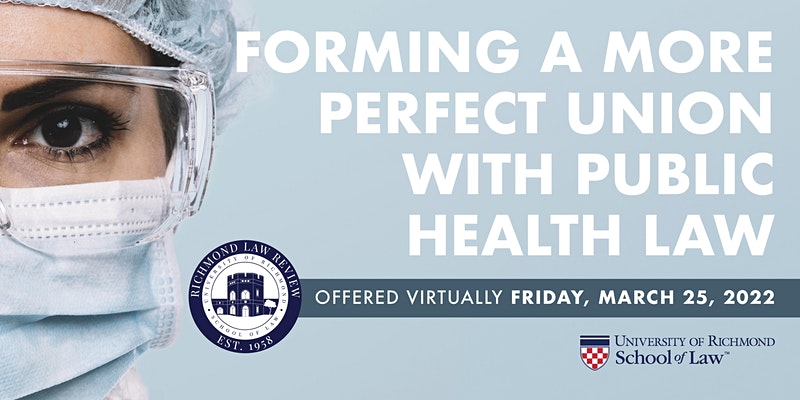
Richmond Law Review Symposium 2022: Forming a More Perfect Union With Public Health Law

Friday, March 25, 2022

CLE Materials: https://richmond.app.box.com/folder/158900899927?v=symposium2022

Six CLE Credits are approved by the Virginia Bar Association

This Symposium will be held virtually via Zoom. An in-person livestream option is available for Richmond Law faculty and students ONLY.

Join the University of Richmond Law Review for a virtual symposium entitled “Forming a More Perfect Union with Public Health Law.” Presentations will reflect on the adaptations occurring in public health law during and after the pandemic. Topics of discussion will include social determinants of health, public trust in health administration, wastewater surveillance, administrative responses to drug-resistant tuberculosis, diverse and transdisciplinary overhauls of health administration, and Medicare and Medicaid reform.

Event is free, but registration is required. Six CLE Credits Approved. Schedule below is subject to change.

9:00 a.m. – Opening Remarks
9:15 a.m. – Health Justice: The Role of Law in Advancing Health Equity | Yael Cannon
10:15 a.m. – Break
10:20 a.m. – Trustworthy Digital Contact Tracing and Health Administration | Jessica Roberts and Chris Ghaemmaghami
11:20 a.m. – Break
11:25 a.m. – The Future of Wastewater Monitoring for the Public Health | Natalie Ram and Lance Gable
12:30 p.m. – Break for Lunch
1:00 p.m. – Legal Responses to Drug-Resistant Tuberculosis Control | Polly Price
2:00 p.m. – Break
2:05 p.m. – Imagining a Better Future for Public Health (Law) | Evan Anderson and Scott Burris
3:05 p.m. – Break
3:10 p.m. – Reforming Age Cutoffs | Govind Persad
4:10 p.m. – Break
4:15 p.m. – Student Comment: Postpartum Medicaid Expansion | Madison Harrell
4:45 p.m. – Closing Remarks


Pretextual Stops: The Rest of the Story

Pretextual Stops: The Rest of the Story

Read Full Article (PDF)


Introduction

Pretextual stops made by law enforcement officers—stops aimed at serving some purpose other than the official reason for the stop—have received renewed attention in the public discourse following several high-profile law enforcement confrontations with people of color. Naturally, the conversations about pretextual stops have centered around their most horrid iteration: discriminatory stops made by bad cops. These stops are damaging to both motorists and officers, and conversations about them are undeniably important. But there is more to pretextual stops than the nefarious purposes attributed to them.

As a former police officer who regularly made pretextual stops for reasons entirely unrelated to race, I’d like to tell the rest of the story (as Paul Harvey would say). Whatever we as a society might decide about pretextual stops, the fact that cops regularly put pretext to use for good should be part of the conversation. To that end, this Essay offers a “boots on the ground” perspective. It aims to share how pretextual stops are used for good, and to shift the focus from how we can eliminate an officer’s discretion to make pretextual stops, to a candid evaluation of which laws are really worth having (and enforcing) and what else we might do to ameliorate the valid concerns that they raise.

I begin in Part I by outlining the doctrine of, and principal concerns with, pretextual stops. I complicate the issue in Part II by discussing the legitimate uses to which police officers regularly put pretextual stops. In Part III, I turn to a few thoughts about how to separate the bad from the good, refocusing the discussion as a question of what laws we want the police to enforce and how we might foster trust between the police and the policed.


J.E.B. Stuart VI*

J.D. 2021, University of Richmond School of Law; B.S. 2013, Virginia Tech
Prior to attending law school, the author served in multiple public-safety positions, including as a patrol deputy with a Virginia sheriff’s office.

Strictly Speaking, What Needs to Change? A Review of How Statutory Changes Could Bring Strict Products Liability to Virginia

Strictly Speaking, What Needs to Change? A Review of How Statutory Changes Could Bring Strict Products Liability to Virginia

Read Full Article (PDF)


Introduction

Virginia remains one of five states that refuse to adopt strict products liability. To date, the Supreme Court of Virginia has declined to follow the path Justice Traynor set out nearly a century ago, as its recent decisions confirm its resistance to strict liability. However, given the change in control of the General Assembly following the elections of 2017 and 2019, the General Assembly is in new hands and may remain that way for some time. This new legislative majority, among its plans for new policies, may soon consider establishing strict products liability by statute. In doing so, Virginia would not be alone. State legislation is the method that four states have already used to adopt strict liability. Others have passed statutes to further limit or expand the reach of liability that their state courts established. Legislation is thus a proven method to adopt and manage strict liability should the General Assembly
take up the effort.

Part I of this Comment briefly reviews the history of Virginia products liability law, and how small changes over centuries have put the Commonwealth on a long line trending slowly towards, but keeping a healthy distance from, modern product liability norms. Part II addresses where Virginia products liability law is today, and how that practically differs from strict liability. Part III explores how Virginia could adopt strict liability without unnecessarily disrupting established precedent and provides a sample statute to accomplish that end.

* Ryan Fowle

 J.D. Candidate, 2022, University of Richmond School of Law


Disrupting Death: How Specialized Capital Defenders Ground Virginia’s Machinery of Death to a Halt

Disrupting Death: How Specialized Capital Defenders Ground Virginia’s Machinery of Death to a Halt

Read Full Article (PDF)


Introduction

Virginia’s repeal of capital punishment in 2021 is arguably the most momentous abolitionist event since 1972, when the United States Supreme Court invalidated capital punishment statutes nationwide. In part, Virginia’s repeal is momentous because it marks the first time a Southern state abolished the death penalty. In part, it is momentous because even among Southern states, Virginia was exceptional in its zeal for capital punishment. No state executed faster once a death sentence was handed down. And no state was more successful in defending death sentences, allowing Virginia to convert death sentences into executions at a higher rate than any other state in the Union. Sure, Texas holds the record for the most executions in the modern era of capital punishment. But Virginia was next in line with the second most executions in the modern era, and it holds the record for the most executions in the history of the United States, period.6 Granted, Virginia had been executing people for over 400 years, so it had a head start. But that just makes its repeal of the death penalty all the more remarkable. How did Virginia go from all-in on the death penalty to abolition?


* Corinna Barrett Lain

** Douglas A. Ramseur

* S.D. Roberts and Sandra Moore Professor of Law, University of Richmond School of Law

** Adjunct Professor of Law, University of Richmond School of Law, and owner of The Ram Law Firm, P.L.L.C., in Richmond, Virginia